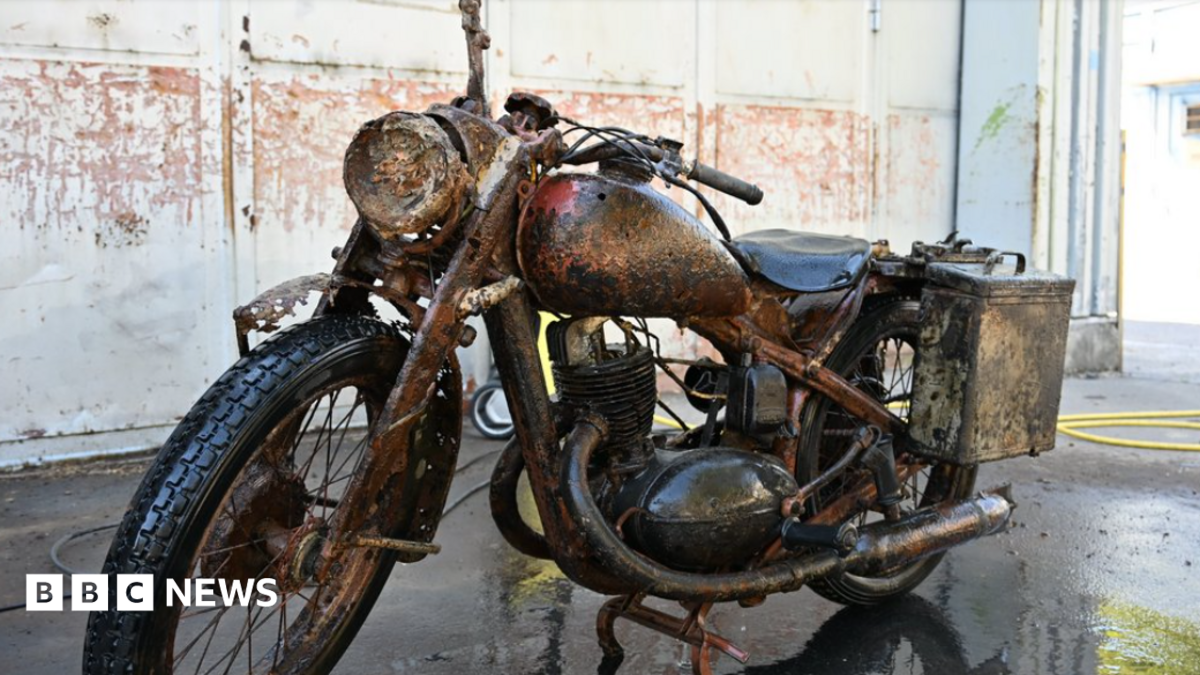
Extreme climate conditions are rewriting history—literally. As severe droughts cause water levels to plummet across Europe, the receding currents of the Danube River in Budapest have exposed a haunting relic of the past: the remains of two World War II German soldiers alongside a remarkably preserved military motorcycle.
For families who spent decades wondering what happened to their loved ones on the Eastern Front, this grim discovery represents a long-awaited piece of an 80-year-old puzzle.
What Was Found in the Receding Waters?
The discovery came to light when a passerby spotted part of a motorcycle frame protruding from the rocky riverbank in downtown Budapest. When recovery teams and bomb disposal units moved in—encountering active anti-tank mines in the process—they uncovered a trove of historical artifacts:
- A Wehrmacht Motorcycle: Believed to be a DKW NZ 350-1 model manufactured specifically for wartime use in 1944.
- Identification Tags: One belonging to a standard Wehrmacht soldier, and another to a member of the Waffen-SS.
- Personal Effects: Including a wedding ring and a Kuban shield (a WWII German combat badge).
Thanks to a protective layer of harbor sludge and oil on the riverbed, items like the identification tags and the motorcycle itself survived decades underwater in astonishingly good condition.
Why This Matters: The Human Cost of History
During World War II, German military ID tags were split in half upon a soldier's death—one half stayed with the body, while the other was sent to army authorities to log casualties and notify families. Because these soldiers vanished into the chaos of the brutal fighting around Budapest, their relatives likely "waited in vain" for official word that never came.
Arne Schrader of the German War Graves Commission noted that the find marks the beginning of a complex forensic puzzle. While cross-referencing the identification tags is the first step, experts will rely on bone analysis to definitively match the remains to the names on the tags before the fallen soldiers receive a final, dignified burial at the German war cemetery in Budaörs.
The Bigger Picture: Climate Meets History
This isn't an isolated incident. Across Europe, plunging water levels on major waterways like the Rhine and the Danube are routinely exposing long-lost historical artifacts and dangerous unexploded ordnance from past conflicts.
While these droughts signal a troubling environmental reality for modern infrastructure, agriculture, and energy production (such as Hungary's nuclear plants), they also serve as an unintended archaeological window. For the descendants of missing soldiers, nature's retreat offers a rare, bittersweet chance to close the book on a century-old tragedy.


