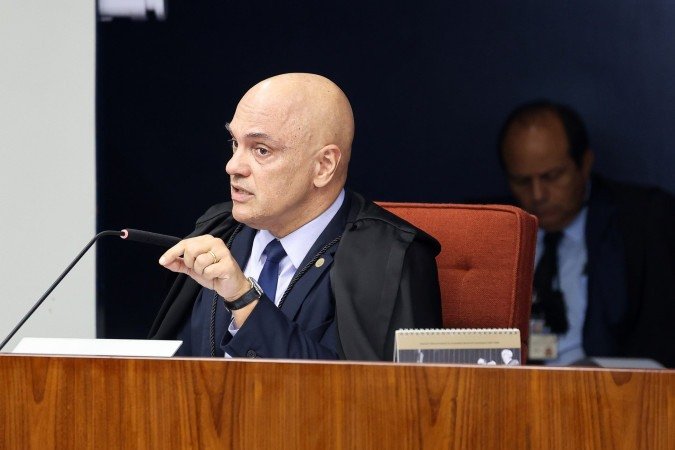
Supreme Court (STF) Justice Alexandre de Moraes has ignited a heated national debate by calling for a critical reassessment of press laws in Brazil. During a recent session of the Court's First Turma, Moraes strongly argued that the constitutional rights protecting freedom of the press cannot be weaponized to commit crimes, shield bad actors, or spread unchecked disinformation.
The conversation kicked off when Justice Flávio Dino suggested that the Supreme Court should revisit a landmark 2009 ruling that eliminated the mandatory requirement for a higher education degree in journalism and professional registration to practice the trade. Dino warned that applying press guarantees automatically to anyone with a blog could eventually allow organized crime factions to infiltrate digital spaces under the guise of journalism.
Moraes strongly backed Dino's perspective, pointing out the glaring loophole in the current digital ecosystem. "Any person wakes up and thinks: starting today, I'm going to be a journalist. They start attacking people on their blog and hide behind freedom of expression," Moraes stated. He suggested it might be time to reflect on reinstating formal educational requirements, complete with a transitional rule for those already working ethically in the field.
Beyond the requirement of a diploma, Moraes emphasized the core constitutional principle that true freedom must always be paired with responsibility. He criticized traditional media outlets for sometimes failing to correct harmful misinformation or acknowledge major errors, referencing historical missteps like the infamous Escola Base case in São Paulo.
The timing of these remarks has added extra fuel to ongoing political discussions. Both Moraes and Dino recently found themselves at the center of separate controversies regarding press privacy and federal investigations, drawing intense scrutiny from media associations, legal experts, and politicians alike.
As digital platforms continue to shift how news is consumed, Moraes warned that leaving the boundaries of journalism undefined risks undermining one of the fundamental pillars of democracy. Whether this high-level discussion will translate into a formal review of the 2009 STF ruling remains to be seen, but the debate over who gets to hold the title of "journalist" in modern Brazil has officially reopened.