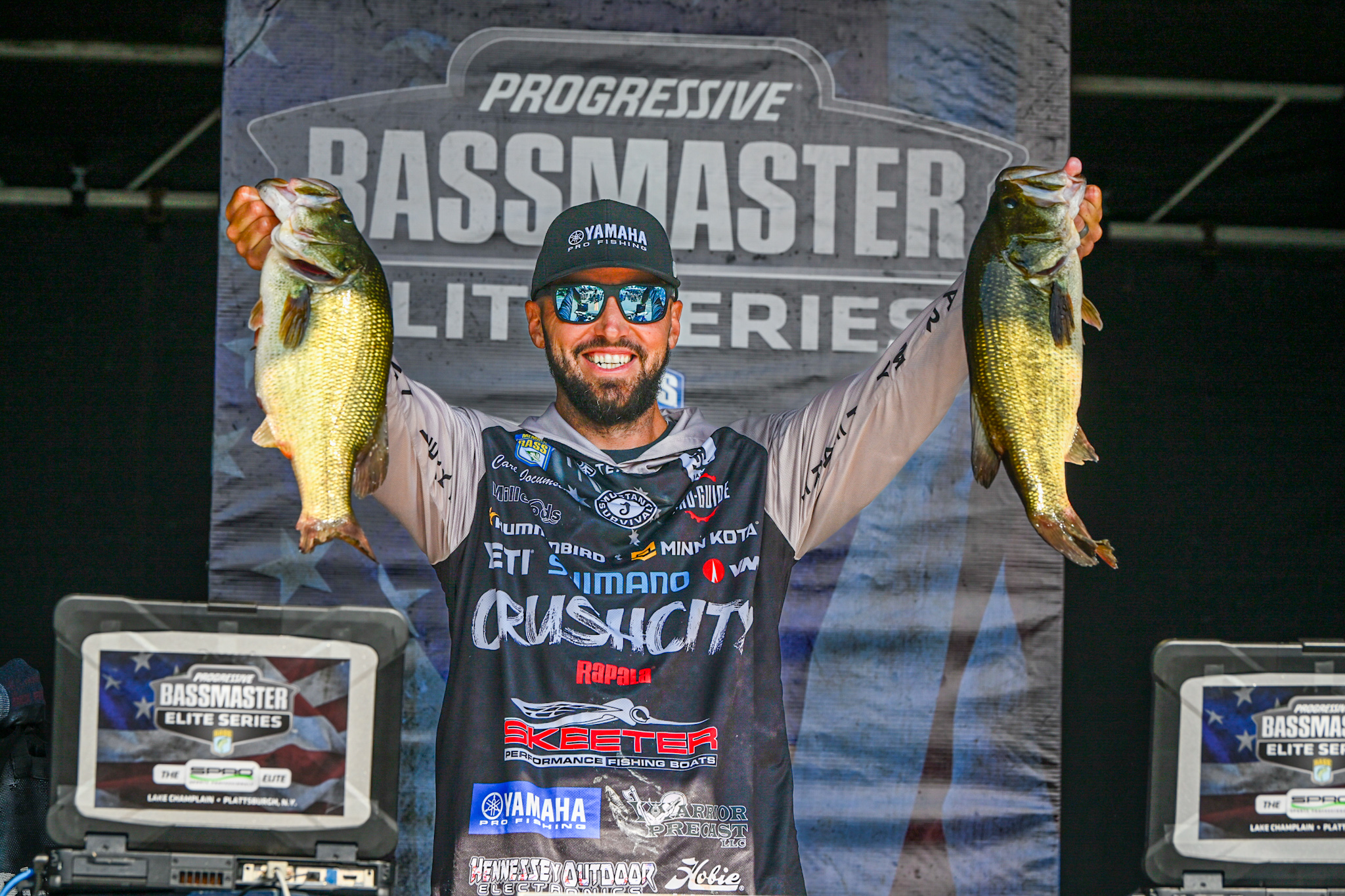
Professional bass fishing is currently locked in a civil war over technology, and Day 1 of the SPRO Bassmaster Elite at Lake Champlain just proved why the debate matters.
For the uninitiated, Forward-Facing Sonar (FFS) has turned modern angling into a high-tech video game, allowing fishers to track and target nomadic fish in real-time. But for the 2026 season, officials threw a wrench into the gears, choosing four events where FFS is strictly banned.
Lake Champlain is one of them. And without their screens to guide them, the world’s best anglers had to rely on raw instinct.
The result? An absolute shakeup at the top of the leaderboard, led by an Australian pro who made a massive, old-school gamble.
The Aussie’s 90-Minute Gamble
With FFS out of the picture, targeting Lake Champlain's famous roaming smallmouth bass became a massive headache. Smallmouth are nomads; without tech, finding them in deep water is like looking for a needle in a wet haystack.
Largemouth bass, however, are homebodies. They stick to structure, weeds, and docks.
Recognizing this shift, Australian pro Carl Jocumsen made a high-stakes decision. He abandoned his initial plans in the north and made a grueling, hour-and-a-half boat run south to Ticonderoga ("Ti")—the lake’s premier, weed-rich largemouth habitat.
The gamble paid off spectacularly. Jocumsen bagged a massive 23 pounds, 2 ounces of largemouth, securing the Day 1 lead by 1 pound, 6 ounces.
"I didn’t come into this event expecting this, but I knew it could be in the plan, for sure," Jocumsen admitted. "I just knew that with the pressure that the north has received, the south end of the lake could be a sneaky area."
To seal the deal, Jocumsen didn't just fish the weeds—he outsmarted the half-dozen other boats in the area by fishing slightly deeper (7 to 8 feet) on the outer edges, letting the heavy fishing pressure push the giant bass right into his zone.
The Chase Pack: Adaptation vs. Baseline
While Jocumsen went all-in on largemouth, the rest of the top three had to adapt to the no-tech rules in their own ways:
- Drew Cook (2nd Place - 21-12): Cook took a hybrid approach. He refused to target largemouth until he secured a "baseline" of smallmouth weight using traditional crankbaits and bladed jigs. Once safe, he pivoted shallow to land a crucial 5-pound, 13-ounce largemouth (currently leading the Big Bass category) on a wacky-rigged SPRO Wacky Snack.
- Chris Zaldain (3rd Place - 21-10): Like Jocumsen, Zaldain focused entirely on largemouth, realizing that smallmouth were simply too unpredictable without sonar. Fishing the northern end of the lake, Zaldain used a unique, off-the-wall presentation that utilized the natural wind currents to trigger bites.
Why This Buzz Matters: Tech vs. Instinct
This tournament is a fascinating case study for the future of professional fishing. For years, purists have argued that FFS dilutes the traditional soul of the sport—the ability to read the water, understand fish behavior, and adapt on the fly.
At Champlain, we are seeing what happens when you strip away the digital training wheels. Anglers like Jocumsen, who can read "little nuances" in a half-mile stretch of grass, are thriving.
Meanwhile, the race for the Progressive Bassmaster Angler of the Year (AOY) is tightening to a razor-thin margin. Trey McKinney currently leads the field with 640 points, but Drew Cook is breathing down his neck at 637, with Canada's Cory Johnston right behind at 634.
With three days of competition left, the leaderboard is anything but set—and the tension on the water is palpable.
Live coverage of Day 2 continues tomorrow on Bassmaster.com and FS1.

