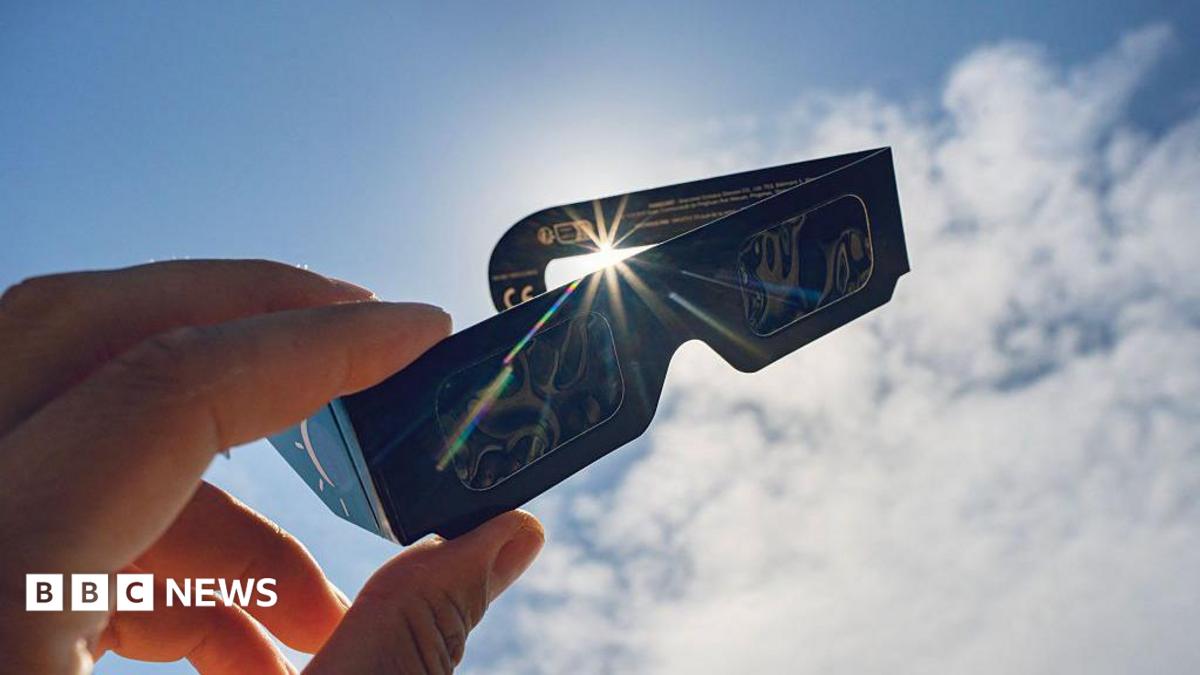
If you walked into a central London bakery this week expecting the smell of fresh croissants, you might have been met with a bizarre sight: queues out the door of people buying cardboard eyewear.
"I've sold, like, 100 this morning," one staff member told reporters.
No, pastry chefs haven’t pivoted to fashion. The UK is on the cusp of its most significant solar eclipse in 27 years, with up to 90% of the sun set to be obscured by the Moon. But as millions prepare to look up, a massive nationwide shortage of safety-certified eclipse glasses has triggered absolute chaos.
Official retailers have completely sold out, leaving desperate sky-watchers scrambling through shady online marketplaces, WhatsApp groups, and corner shops just to secure a view.
The Tech Spec: Why "ISO 12312-2" is the Only Code That Matters
If you’ve managed to snag a pair of glasses online, do not look at the sun until you have checked the frame for five critical characters: ISO 12312-2.
This is the international safety standard for direct solar viewing. These aren't just dark plastic; they are highly specialized filters.
According to astronomers, true solar eclipse glasses are "very, very different" from your standard designer sunglasses. They block out so much light that when you put them on, you shouldn't be able to see anything at all—except the sun itself.
⚠️ WARNING: Normal sunglasses will NOT protect your eyes. In fact, they make things worse.
Because sunglasses reduce glare, they make it more comfortable to stare at the sun for longer periods. However, they do nothing to block the infrared and ultraviolet radiation actively cooking your retinas.
The Invisible Danger: Why You Won’t Feel the Burn
Why are health officials being so dramatic about a brief peak at the sun? It comes down to basic biology.
The human retina has no pain receptors. If you damage your eyes during the eclipse, you won't feel a thing while it's happening.
"Crucially, people will not feel the damage as it happens," warns Mohamed Elalfy, president of the Royal College of Ophthalmologists.
The danger is very real. During the UK's last major total solar eclipse in 1999, the Royal College reported around 70 cases of severe, lasting vision damage. Shockingly, 40% of those patients had looked at the sun for less than a single minute.
Fake Glasses and WhatsApp Scalpers
With official outlets like the Royal Museums Greenwich completely sold out due to "unprecedented" demand, the black market has stepped in to fill the void.
- WhatsApp Groups: Thousands of people have joined viral group chats tracking which local corner shops still have stock.
- Online Scams: Reddit and Facebook threads are flooded with third-party sellers charging astronomical fees for bulk orders.
- Counterfeit Warnings: The UK Health Security Agency (UKHSA) has issued urgent warnings to avoid buying unverified glasses online. If a product does not have verified certification, do not risk your eyesight.
Using binoculars, telescopes, or even a smartphone camera viewfinder with eclipse glasses on is also a recipe for disaster. The magnifying lenses on these devices act like a magnifying glass under the sun, instantly melting through the protective filter of your glasses and causing immediate eye damage.
Missed the Boat? Here is Your Safest Plan B
If you couldn't get your hands on a pair of ISO 12312-2 glasses, don't panic. You can still experience this once-in-a-generation event safely using a low-tech classic: The Pinhole Projector.
How to Make a Pinhole Projector in 30 Seconds:
1. Take two sheets of white card.
2. Poke a small, clean hole in the center of one sheet using a pin.
3. Stand with your back to the sun.
4. Hold the pinhole card up, letting the sunlight pass through the hole onto the second card.
5. A perfect, safe projection of the crescent sun will appear on the paper!
Alternatively, you can watch the event via official live broadcasts.
"We're not going to get one this good for a really long time," says Imo Bell, a planetarium astronomer at The Royal Observatory Greenwich. "So, it's important not to miss it—but to be prepared."