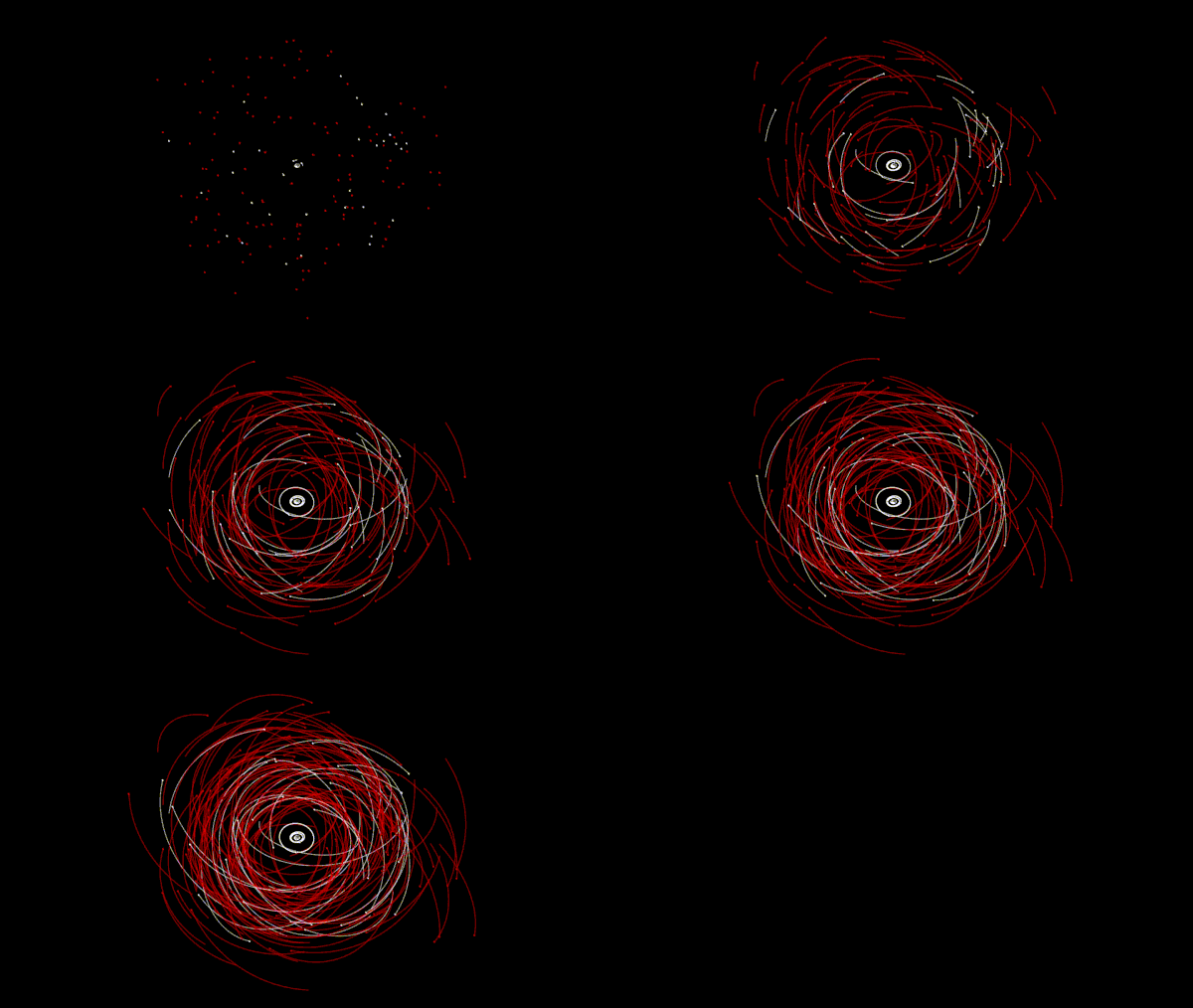
The cosmos just got a whole lot more crowded! In a stunning announcement on March 16, 2026, the Minor Planet Center confirmed a monumental jump in the known moon counts for our solar system's gas giants. Saturn, already crowned the "King of Moons," added another 11 to its entourage, pushing its grand total to an astonishing 285. Not to be outdone, Jupiter finally cracked the century mark, gaining 4 new celestial companions to reach a whopping 101 moons!
Unpacking the Latest Celestial Census: Saturn’s Unprecedented Moon Count Jumps to 285!
This isn't just about bigger numbers; it's about what these discoveries tell us about the hidden mechanics of our solar system. For context, it was only last March that Saturn's moon count saw a massive boost of 128 additions, showcasing the accelerating pace of astronomical discovery. Now, less than a year later, we're doing it again.
These aren't your easily-spotted, shining-bright-in-the-night-sky kind of moons. The newly discovered satellites for both Saturn and Jupiter are incredibly small, typically just 2 miles (3 km) across. To put that in perspective, they're roughly the size of a small town! And if their diminutive stature wasn't enough, they're also incredibly faint, with magnitudes ranging from +25 to +27 – a stark contrast to the Sun's blinding -26 or Venus's brilliant -4.
Why Were These Tiny Outer Solar System Moons Hidden Until Now?
The answer lies in their elusive nature. Not only are they tiny and dim, but they also orbit far, far away from their planetary hosts. Imagine trying to spot a pebble in a vast ocean while looking through a telescope from miles away; that's the challenge astronomers face. Saturn’s moon system alone, for example, stretches across a distance equivalent to five full Earth moons seen from our perspective!
The truth is, these moons aren't "new" in the cosmic sense. They've been there all along, silently orbiting for billions of years. What is new are our eyes on the sky.
The Technology Behind the Discovery: How Vera C. Rubin Observatory is Revolutionizing Astronomy
The breakthroughs of the past few years, including these latest additions, are a testament to rapidly advancing observational technology. Astronomers are leveraging powerful new telescopes and sophisticated data analysis techniques. A major player in this ongoing celestial scavenger hunt is the Vera C. Rubin Observatory, which went online in June 2025.
Rubin's strength lies in its ability to scan the entire visible sky every few nights, meticulously cataloging changes. It's designed to spot the slightest movements and variations in brightness, sending out hundreds of thousands of alerts to astronomers daily. This relentless monitoring allows researchers to piece together observations over time, identifying faint objects that move just enough to confirm their orbital dance around a planet. It's a game-changer for finding these shy, distant members of our solar system.
What Do These Small, Irregular Moons Tell Us About Our Solar System?
These tiny, irregular moons are more than just numbers on a celestial scorecard. They are invaluable relics, offering clues about the early history and formation of our solar system. Their irregular orbits and small size suggest they might be captured asteroids or remnants of larger bodies shattered by ancient collisions. Studying their compositions and orbital patterns can help scientists reconstruct the chaotic cosmic ballet that shaped our planetary neighborhood billions of years ago.
Naming the Unseen: The Rules for Designating Distant Planetary Satellites
While names like Titan and Ganymede evoke grandeur, most of these newly discovered moons won't receive such poetic designations. The International Astronomical Union’s Committee for Planetary System Nomenclature has strict rules: only moons brighter than an absolute magnitude of 16.5, or those with significant scientific interest, are typically granted proper names. Given that these new finds hover around magnitudes +25 to +27, they'll likely remain known by scientific designations rather than names.
For now, Saturn firmly holds its title as the solar system's moon monarch, leaving Jupiter a distant second. But with observatories like Rubin continually sweeping the skies, who knows what other hidden worlds are waiting to be discovered? The quest to fully map our cosmic backyard is far from over!