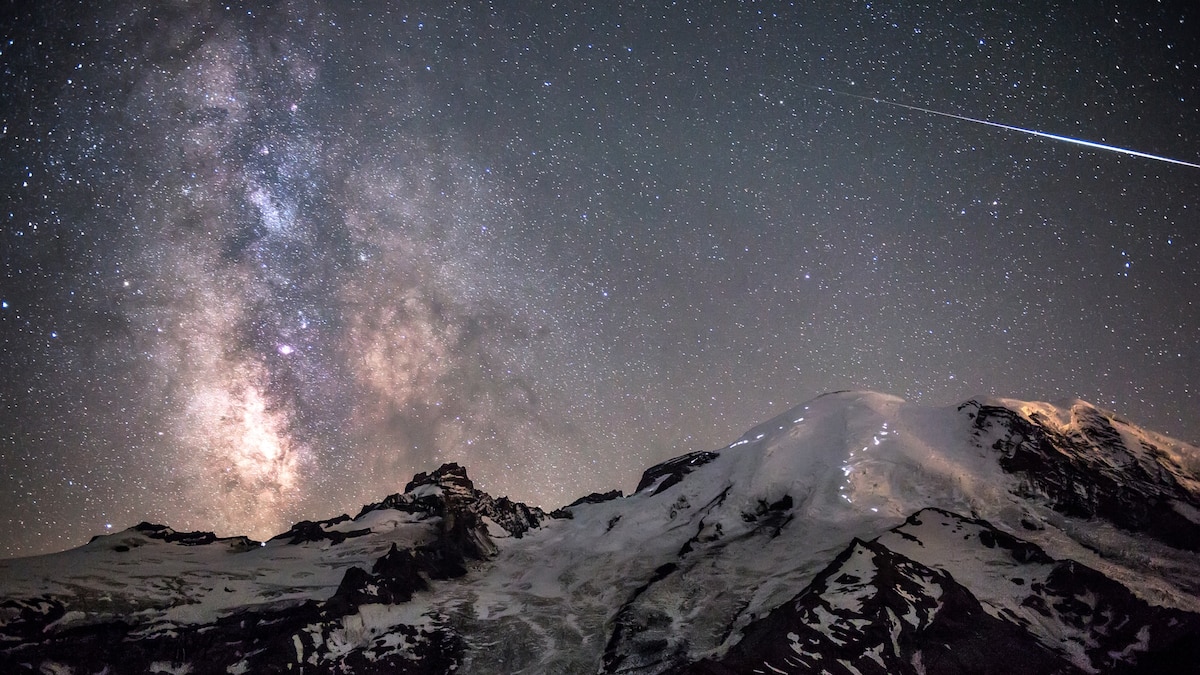
The night sky is about to throw a celestial curveball, serving up not one, but two meteor showers peaking on July 30 and 31, 2026. Prepare for a cosmic double feature as the Southern Delta Aquariids and Alpha Capricornids cross paths. But here’s the buzzkill: July’s full moon is set to play spoiler, casting a brilliant glow that could dim the spectacle.
So, is it even worth staying up? Absolutely. While the moonlight will undeniably complicate things, the Alpha Capricornids are famous for their brilliant "fireballs"—a showstopping phenomenon that might just punch through the lunar glare, making your late-night vigil entirely worthwhile.
Why This July Meteor Shower Overlap is a Rare Celestial Event
Imagine two different cosmic highways, each littered with ancient space debris, suddenly intersecting with Earth's orbit at the exact same time. That's essentially what's happening. Experts like Devon Salasin, head astronomer at Stargazing Moab, call it "complete happenstance" that the debris trails from two distinct comets align for our planet to pass through simultaneously.
From mid-July to late August, the Southern Delta Aquariids grace our skies, typically delivering around 25 faint streaks per hour under ideal conditions. Running from early July into mid-August, the Alpha Capricornids are a different beast. While fewer in number—only about five per hour—they are renowned for their slow, dazzling fireballs. "Besides originating from slightly different spots in the sky, what is known as the radiant of the meteor showers, the Delta Aquariids offer more frequent, faint streaks, while the Alpha Capricornids are famous for slower, dazzling fireballs," explains Alex Gianninas, an astronomy professor at Connecticut College.
Navigating the Lunar Glare: Why the Full Moon is a Challenge for Skywatchers
Here’s the rub: July’s full moon peaks on July 29. By the peak nights of the meteor showers, the moon will still be approximately 98 percent illuminated. This means a brilliantly lit night sky, turning what could be a celestial blockbuster into a challenging scavenger hunt for fainter meteors. The moon's glare acts like a cosmic floodlight, washing out much of the sky's natural darkness.
However, don't pack up your lawn chairs just yet. While the fainter Southern Delta Aquariids might be largely obscured, the truly exceptional Alpha Capricornid fireballs possess the brilliance to shine through the lunar interference. This is your chance to witness something truly spectacular.
The Science Behind Shooting Stars: How Meteor Showers Work
What exactly are you seeing when a "shooting star" streaks across the night sky? It's not actually a star falling. Meteor showers occur when Earth plows through streams of cosmic dust and rock left behind by comets. As these particles, often no bigger than grains of sand, slam into our atmosphere at immense speeds, they superheat and ionize, creating the luminous streaks we observe.
Demystifying Fireballs: What Makes Them Unusually Bright Meteors?
A "fireball" is in a league of its own. It's an unusually bright meteor—significantly brighter than your average shooting star. Professor Gianninas notes that while most meteors are tiny, fireballs are produced by much larger chunks of space rock, ranging from "pebble to boulder-sized." This increased size means a more dramatic entry into our atmosphere, burning hotter and brighter.
What's more, these aren't just bright flashes. Fireballs often travel more slowly, leaving behind persistent glowing trails that linger for moments after the meteor itself has vanished. Salasin adds that the "colors of various ionizing elements can be more visible," offering a truly multi-sensory celestial experience.
Maximizing Your Chances: How to See July's Meteor Showers Despite the Moon
Even with the moon's uncooperative brightness, you can still optimize your chances of catching an Alpha Capricornid fireball.
- Find Your Darkest Spot: Get away from city lights as much as possible. Light pollution, combined with moonlight, will make viewing nearly impossible.
- Eyes On The Prize (and Adjusted): Give your eyes at least 20 minutes to adjust to the darkness. Avoid looking at your phone!
- No Gear Needed: Forget the telescope or binoculars. Meteors can appear anywhere in the sky, so a wide, unobstructed view is best. Recline in a chair or on a blanket.
- Timing is Everything: Both showers are best viewed after midnight, when their radiant points—the area of the sky from which they appear to originate—are higher.
- Patience is a Virtue: As Salasin advises, "Stay with it, and you can maybe see a glimpse of what this shower is best known for—slow-moving, bright fireballs."
Beyond July: What Other Night Sky Events Are Coming in 2026?
Don't fret if the moon largely spoils this month's show. The cosmos has more in store. The next major event is the Perseids, one of the year's most prolific and reliable meteor showers, set to peak on the night of August 12 into the morning of August 13. This time, the moon will be less of an issue, promising a truly spectacular display visible across most of the Northern Hemisphere and down to the Southern Hemisphere's mid-latitudes.
And for an added twist, August 12 also features a total solar eclipse, though its path is limited to Greenland, Iceland, and Spain. So mark your calendars, because even when one door closes (or dims), the universe often opens another, even more dazzling, window.