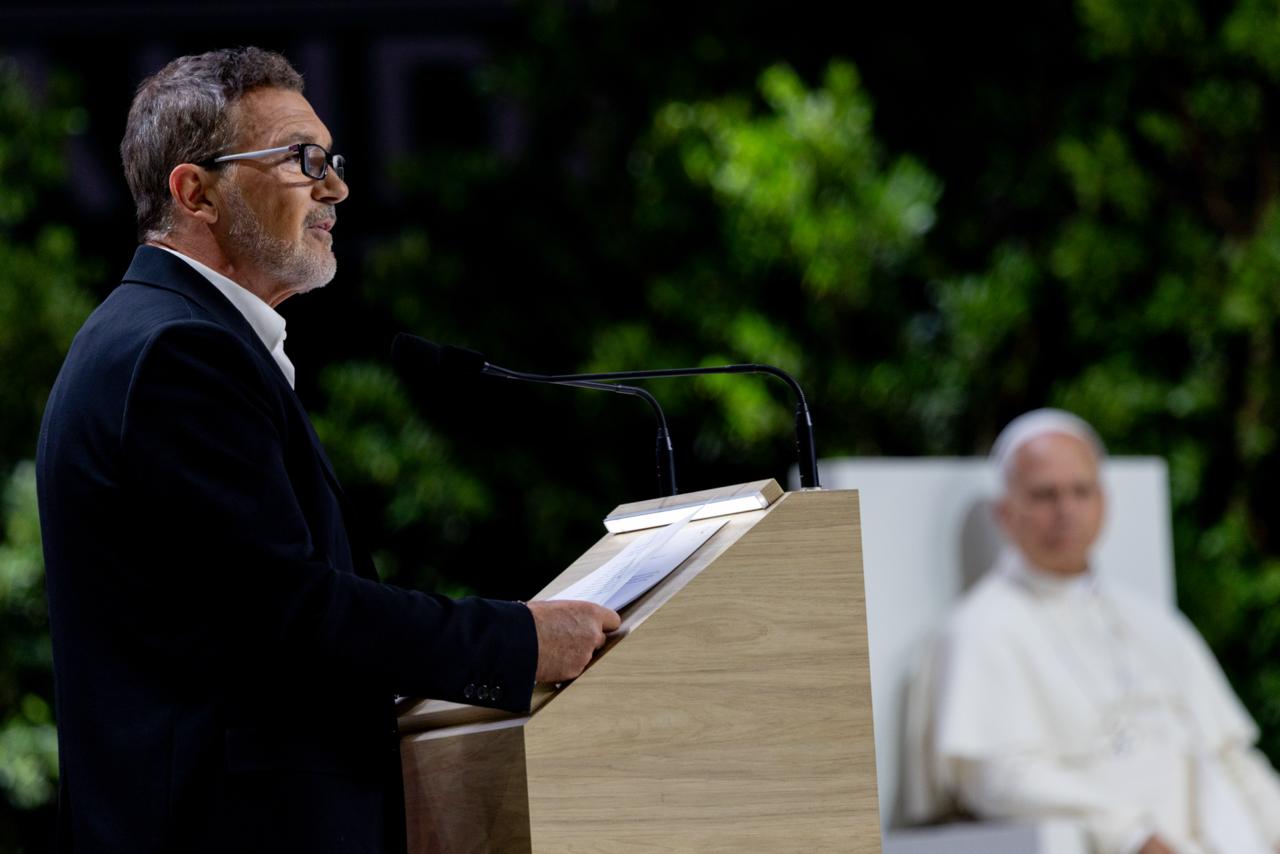
In a world increasingly polarized and digitally fragmented, an unlikely, yet powerful, summit just took place in Madrid. Hollywood's own Antonio Banderas, known globally for his charismatic roles, found himself sharing a stage not with a fellow star, but with Pope Leo XIV. This wasn't a red carpet premiere; it was a profound gathering exploring faith, art, and the very essence of humanity.
The Unlikely Summit: Why Antonio Banderas Met Pope Leo XIV in Madrid
Madrid’s Movistar Arena transformed this past Sunday into a modern-day "Court of the Gentiles," a space where diverse voices converged under the spiritual guidance of Pope Leo XIV. The occasion was part of the Pope’s first apostolic visit to Spain in 15 years, themed "Lift up your gaze," a poignant call for introspection and unity amidst global challenges.
Among the leading lights of Spanish culture present was none other than Antonio Banderas, the globally renowned actor whose presence instantly elevated the event's profile. He was joined by legendary badminton player and three-time world champion Carolina Marín, alongside prominent academics, labor union representatives, and business leaders. The sheer diversity of attendees underscored the Pope’s mission: to weave networks and build bridges across societal divides, proving that even in a fractured society, encounter remains possible.
Antonio Banderas's Bold Confession: "A Victim of God’s Spell"
Perhaps the most talked-about moment came during Banderas's address, a surprisingly candid reflection on the unbreakable bond between faith and culture. Looking directly at Pope Leo XIV, the actor made a striking confession: "I confess that I am a victim of God’s spell."
This powerful declaration wasn't just a turn of phrase; it resonated deeply with Banderas's recent work. The day before, he had directed the cast of the musical Godspell during a youth vigil in Madrid. His speech further connected his personal journey to the popular piety of his native Málaga, specifically recalling the vivid Holy Week processions that shaped his childhood and left an indelible mark.
Art vs. AI: Banderas on Recovering Humanity's Soul in a Digital Age
Beyond personal revelation, Banderas articulated a crucial perspective on the role of art in our hyper-modern age. In a world increasingly dominated by algorithms, soundbites, and fleeting trends, he argued for art's indispensable ability to provoke deep thought and recover lost meaning.
"In a world that at times is overly simplified," Banderas asserted, "art helps us recover the depth and the soul that is trying to be stolen by artificial intelligence." This isn't just a celebrity opining; it's a poignant warning from an artist about the potential erosion of human experience by technological advancement, a powerful call to cherish the complexities that truly define us.
Pope Leo XIV's Vision: Weaving Networks for a United Future and Common Good
The Pope himself echoed these sentiments of depth and connection, laying out a compelling vision for a society built on dialogue and collaboration. His message, centered on "weaving networks," wasn't just abstract rhetoric; it was a practical blueprint for overcoming fragmentation and polarization. As a "bridge builder" – the very meaning of "Pontiff" – Pope Leo XIV emphasized an approach rooted in "encounter, listening, dialogue, and respect."
He detailed how this "weaving" translates into concrete action: universities engaging with the world of work, businesses valuing employees beyond mere economics, art reaching beyond elite circles, and sports transcending pure spectacle. He also stressed that technological progress must always consider the vulnerable, ensuring no one is left voiceless.
The Church's Enduring Dialogue with the Modern World
Addressing Cardinal José Cobo, the Archbishop of Madrid, Pope Leo XIV positioned the Church as a steadfast reference point against extremism, a force committed to fostering cultural and artistic encounter. He affirmed the Church's "longing to remain in dialogue with the contemporary world," acknowledging both its historical successes and failures.
Citing his own encyclical, Magnifica humanitas, published May 25, 2025, the Pope returned to the fundamental question: "What does it mean to be truly human?" His answer was clear: "The Church shares with humility, but also with firmness, what she has discovered through the experience of faith: that Jesus Christ responds to the great questions about human life and its fullness." He challenged attendees to consider Europe's identity without its spiritual foundations, asking why there should be fear of eternity permeating daily life.
This historic meeting between a global screen icon and a spiritual leader wasn't just a photo op. It was a potent reminder that in our relentless quest for progress, the deeper questions of faith, culture, and what it means to be human remain profoundly relevant. As Banderas and Pope Leo XIV demonstrated, sometimes the most unexpected dialogues are the ones that offer the most compelling answers.